
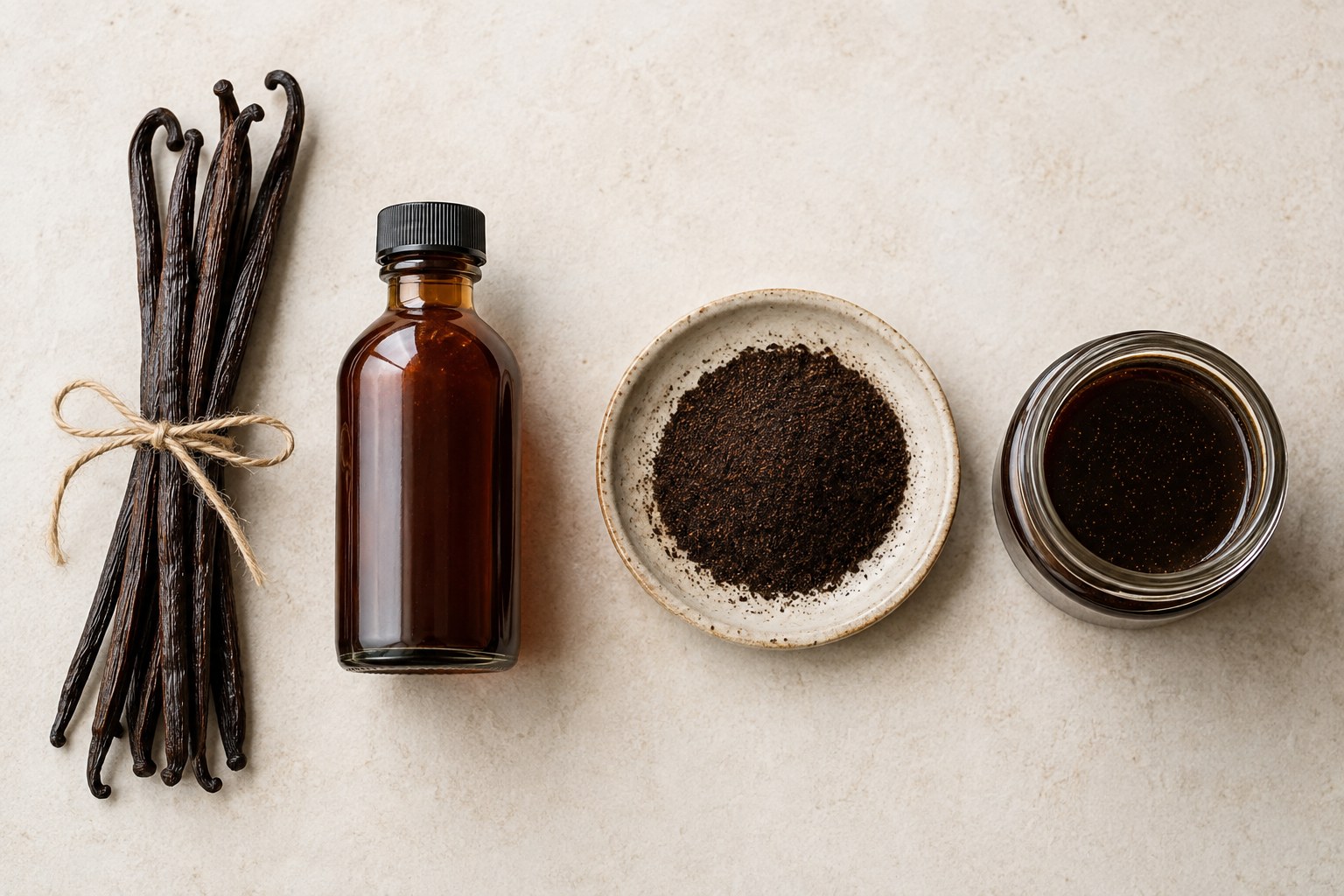
If you’re mid-recipe and just realized you’re out of vanilla beans, here’s the short answer: 1 whole vanilla bean = 2 teaspoons pure vanilla extract = 1 teaspoon vanilla powder = 2 teaspoons vanilla paste. Each substitute works, but they differ in flavor depth, appearance, and sweetness. The right choice depends on what your recipe actually needs.
The Substitution Ratios at a Glance
| What You Have | Equivalent to 1 Whole Bean |
|---|---|
| Pure vanilla extract | 2 teaspoons |
| Vanilla powder | 1 teaspoon |
| Vanilla paste | 2 teaspoons |
| Vanilla sugar | 1–2 tablespoons (reduce other sugar) |
| Imitation vanilla extract | 2 teaspoons (last resort) |
These ratios stay consistent whether you’re scaling up or down. Half a bean? Use 1 teaspoon extract or ½ teaspoon powder. Quarter of a bean? You get the idea.
Substitutes Ranked by Fidelity
1. Vanilla Powder (Closest Substitute)
Vanilla powder is ground whole vanilla beans — nothing added, nothing removed. It keeps the dark specks that signal real vanilla in a finished dish, it’s alcohol-free, and it handles high heat without flavor loss. For baking, custards, and dry spice rubs, powder is the most faithful swap you can make. Use 1 teaspoon per bean called for.
One practical note: powder has no liquid, so it won’t affect batter consistency the way extract does.
2. Vanilla Paste
Paste delivers both the specks and a full vanilla flavor, and it measures the same as extract (2 teaspoons per bean). The trade-off is that most commercial pastes contain sugar or corn syrup. In a simple syrup, glaze, or frosting, that added sweetness is barely noticeable. In a delicate custard where you’ve dialed in your sugar precisely, account for it.
3. Pure Vanilla Extract
Extract is the most common substitute and the easiest to measure. Two teaspoons replaces one whole bean. You lose the visual specks, but the flavor comes through clearly — especially in baked goods where the bean itself wouldn’t have been visible anyway. Always use pure extract, not imitation. The difference in a finished recipe is real and detectable.
For more on quantities and when to use each form, see our vanilla FAQ.
4. Vanilla Sugar
Vanilla sugar works as a partial substitute — it adds vanilla fragrance but at a lower concentration than extract or powder. Use 1 to 2 tablespoons per bean and reduce the sugar in your recipe accordingly. Best in shortbreads, whipped cream, and other recipes where the vanilla plays a supporting role.
5. Imitation Vanilla (Last Resort)
Imitation vanilla is synthetic vanillin — typically derived from wood pulp or petrochemicals — without the 200-plus flavor compounds that make real vanilla complex. It smells sharper and flatter than the real thing. Use the same volume as pure extract (2 teaspoons per bean), but know that in recipes where vanilla is a lead flavor — ice cream, crème brûlée, pound cake — the difference is obvious. We mention it here for completeness, not as a recommendation.
When You Should Not Substitute
In crème brûlée, panna cotta, vanilla bean ice cream, and similar recipes, the scraped pod isn’t just a flavor delivery mechanism. The visual of the seeds suspended in cream, the textural contrast of the pod steeped in hot liquid — these are part of the dish. A substitute will produce something that tastes like vanilla, but not something that looks or feels right. These are the moments to restock whole beans and make the recipe when you have them.
Going the Other Direction: You Have Beans, Recipe Calls for Extract
Split the bean lengthwise, scrape the seeds, and use the seeds from half a bean in place of 1 teaspoon of extract. You can steep the scraped pod in your warm liquid (milk, cream, sugar syrup) for 15–20 minutes to pull additional flavor, then discard it.
Frequently Asked Questions
Can I skip vanilla entirely? Yes, but you’ll notice it. Vanilla doesn’t just add its own flavor — it rounds out and deepens other flavors, especially chocolate, butter, and eggs. Leaving it out rarely ruins a recipe, but it makes a good recipe merely okay.
Is imitation vanilla the same as pure vanilla extract? No. Pure vanilla extract is made by macerating real vanilla beans in alcohol and water. Imitation vanilla contains synthetic vanillin and lacks the full flavor profile of the real bean. In side-by-side tests, most people can tell the difference.
How much vanilla powder equals one bean? One teaspoon of vanilla powder equals one whole vanilla bean. Because powder is made from ground whole beans, it’s the most concentrated and botanically complete substitute available.
Amadeus has been importing vanilla directly from family farms and co-operatives since 1994. Cassie and Marty are happy to help you find the right form for your recipes — browse our gourmet vanilla beans to restock when you’re ready.