
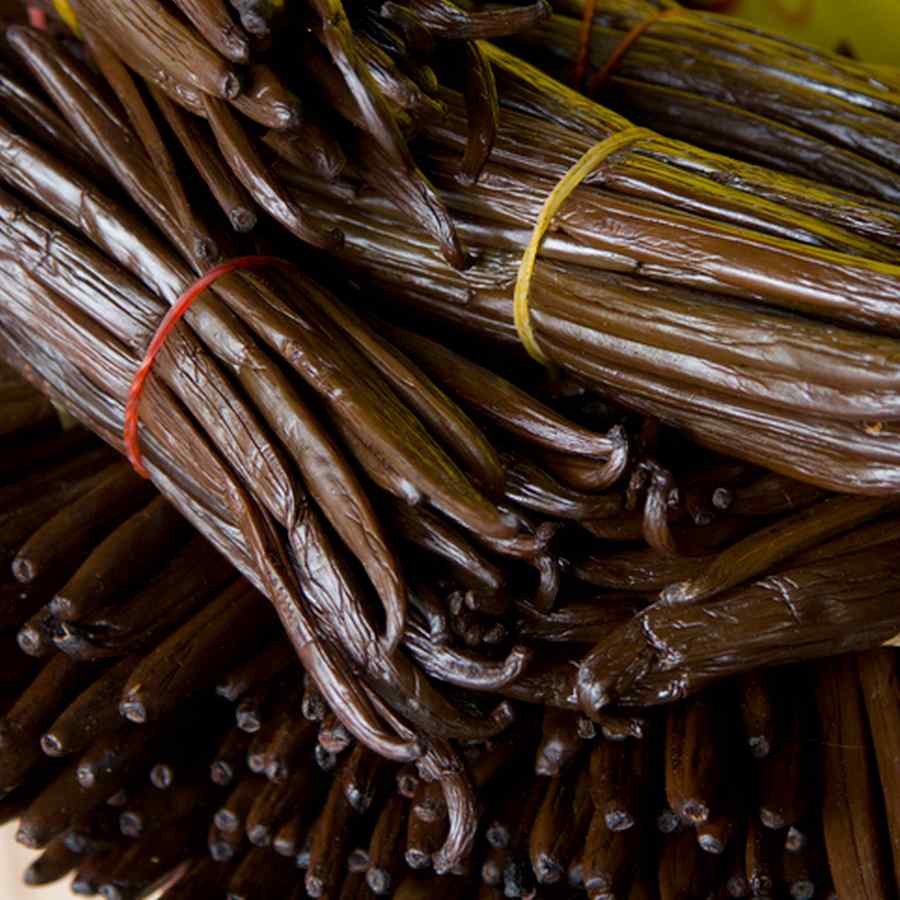
Madagascar vanilla is the go-to for most baking — rich, creamy, high vanillin. Mexican vanilla carries a spicier, earthier character that pairs especially well with chocolate. Tahitian vanilla beans are the aromatic outlier: floral and cherry-like, lower in vanillin, and best used in cold preparations where heat won’t drive off its delicate compounds. For extract making, Madagascar gives the strongest single-origin result.
If you’ve spent time shopping for vanilla beans and wondered why the options keep multiplying, this guide covers the three you’ll encounter most often. The differences are real, they’re measurable, and once you understand them, you’ll stop reaching for whichever origin is on sale and start choosing the one that actually fits what you’re making. For a deeper look at origins, grades, and what to look for when shopping, see our guide on buying vanilla beans.
Where each bean comes from
Madagascar Bourbon vanilla
Madagascar accounts for roughly 80% of the world’s vanilla supply. The beans grown there are Vanilla planifolia — the same species as Mexican vanilla — but the Sava region in northeastern Madagascar produces a flavor that’s become the global benchmark for what vanilla should taste like. Pollination is done entirely by hand; each flower blooms for a single day and the window to hand-pollinate it is a few hours. That labor is part of why Madagascar vanilla costs what it does.
Cassie and Marty have sourced directly from farming co-operatives in Madagascar since 1994. The Grade A beans they carry — long, dark, plump, 17 cm+ — are the ones you’ll find in cookbooks and bakeries that take their sourcing seriously.
Mexican vanilla
Vanilla originated in Mexico. The Totonac people of Veracruz were cultivating it centuries before it reached Europe, and genuine Mexican vanilla is still grown primarily in the Papantla region of Veracruz state. It’s Vanilla planifolia, same as Madagascar, but the soil, curing process, and climate produce a noticeably different character: earthier, with a light spice note and a woody undertone that’s less creamy than Madagascar and more complex in a different direction.
One thing worth knowing: a lot of “Mexican vanilla” sold in tourist markets and cheap online listings is synthetic vanillin in a carrier, not real vanilla extract. Genuine Mexican vanilla beans are identifiable by their plump, slightly oily, reddish-brown pods and a rich, spicy aroma. If you’re making homemade vanilla extract, visit our extract maker guide for bean recommendations and ratios.
Tahitian vanilla
Tahitian vanilla is a different species: Vanilla tahitensis. Despite the name, most Tahitian-type beans sold commercially don’t come from Tahiti — the island’s commercial vanilla production is tiny. Most are grown on the island of New Guinea, in Papua New Guinea and in Indonesia’s Papua region, where V. tahitensis thrives. Amadeus sources ours from Papua New Guinea.
Tahitian beans are plumper than Bourbon planifolia, with higher moisture content and a distinctly different aromatic profile: floral, cherry-like, with an anise or licorice undercurrent. The compound responsible is heliotropin, which V. tahitensis produces in much higher concentrations than V. planifolia. The tradeoff is lower vanillin — which means less of the classic vanilla flavor and weaker extract performance.
Flavor profiles at a glance
| Madagascar | Mexican | Tahitian | |
|---|---|---|---|
| Primary notes | Rich, creamy, rum/raisin | Spicy-sweet, earthy, woody | Floral, cherry, anise |
| Vanillin content | High | High | Lower |
| Heat stability | Excellent | Excellent | Poor — aromatics cook off |
| Bean length (Grade A) | 17 cm+ | 14–17 cm | 17 cm+ (plumper) |
| Best use | Extract, baking, anything | Chocolate, coffee, caramel | Ice cream, pastry cream, cold infusions |
Which to use for each application
Making vanilla extract
Use Madagascar as your base. High vanillin content, reliable extraction, and the familiar flavor most people expect from pure vanilla extract. If you want a more complex blended extract, add 20–30% Tahitian beans — the floral aromatics survive infusion better than oven heat, so cold extraction lets them come through. Mexican beans also make solid extract, especially for baking blends destined for chocolate chip cookies or spiced cakes.
Browse: Madagascar extract-grade beans · Tahitian extract-grade beans
Everyday baking
Madagascar is the right default for anything that goes in the oven. Cookies, cakes, quick breads, baked custards — Madagascar holds up to heat, delivers clean vanilla flavor, and won’t surprise you. If a recipe calls for “vanilla bean” without specifying origin, Madagascar is what the author almost certainly tested with.
Chocolate desserts and coffee applications
Mexican beans earn their keep here. The earthy, slightly spicy quality of Veracruz vanilla adds depth alongside dark chocolate in a way Madagascar doesn’t — it amplifies the complexity rather than softening it. Chocolate mousse, mole sauce, coffee syrup, and chocolate truffles are where Mexican vanilla makes a real difference.
Ice cream, pastry cream, and panna cotta
This is where Tahitian beans are worth seeking out. The finished product is cold or barely warm, which means heliotropin survives to express itself. Split a Tahitian bean and steep it in your cream — the floral, cherry-like quality comes through in a way that makes the ice cream taste noticeably more interesting than the same recipe made with Madagascar. Pastry cream for tarts, panna cotta, vanilla milkshakes, and crème brûlée (where the custard is chilled after cooking) all benefit from Tahitian.
Cold infusions
Cold-brew vanilla coffee, overnight-infused simple syrups, flavored cream left to steep in the refrigerator — these are the applications where Tahitian’s low heat-stability stops being a drawback and becomes an advantage. No heat means no aromatic loss. The result is intensely fragrant.
The quick decision guide
Choose Madagascar if you want the most reliable all-purpose vanilla. It’s the right bean for extract making, everyday baking, and any recipe where vanilla is the primary flavor. Browse Madagascar Grade A gourmet beans.
Choose Mexican if you’re working with chocolate, coffee, or anything that benefits from a more complex, slightly spicy vanilla note. Browse Mexican Grade A gourmet beans.
Choose Tahitian if you’re making ice cream, pastry cream, or cold infusions where the aromatic compounds will survive. It’s also the bean to reach for when you want a more floral, complex blended extract. Browse Tahitian Grade A gourmet beans.
Can you use all three?
Yes — and many serious home bakers do. Keeping a small supply of each gives you a different tool for different recipes. Madagascar is the workhorse. Mexican comes out for chocolate-adjacent recipes. Tahitian earns its place in summer ice cream season and holiday pastry cream.
For blended extract, a 60/25/15 split (Madagascar/Mexican/Tahitian) is a good starting point. The Madagascar carries the strength, the Mexican adds depth, and the Tahitian contributes floral notes at the back.
Cassie and Marty have been importing vanilla directly from family farms and grower co-operatives since 1994. Browse the full origin lineup at Amadeus Vanilla Beans.
What does Madagascar vanilla taste like?
Madagascar vanilla (Bourbon vanilla) has a classic creamy, rich flavor with notes of cream, caramel, and warm spice. It is the most widely used origin and the flavor most people associate with vanilla.
What does Mexican vanilla taste like?
Mexican vanilla is made from the same Planifolia species as Madagascar but grown in vanilla’s original habitat. The flavor is similar — creamy and rich — with slightly spicier, earthier undertones.
What is Tahitian vanilla and when should I use it?
Tahitian vanilla (Vanilla tahitensis) is a different species with a distinctly floral, fruity aroma with cherry and anise notes. It works best in cold applications — ice cream, pastry cream, panna cotta, and fruit desserts — where its delicate fragrance won’t cook off.
Which vanilla bean origin is best for making extract?
Madagascar Grade B beans are the most popular for extract — classic flavor and excellent value. Uganda Grade B produces a bolder, darker extract with chocolate and fudge notes. Indonesia Planifolia is nearly identical to Madagascar at a slightly lower cost.
Can I blend different vanilla bean origins?
Yes. Blending is common among artisan extract makers. A popular combination is 60% Madagascar for body, 30% Indonesia for volume, and 10% Tahitian for a floral top note. Experiment with ratios to develop your own signature blend.
For a deeper look at our Madagascar sourcing and full product lineup, see our Madagascar Vanilla Beans page.