
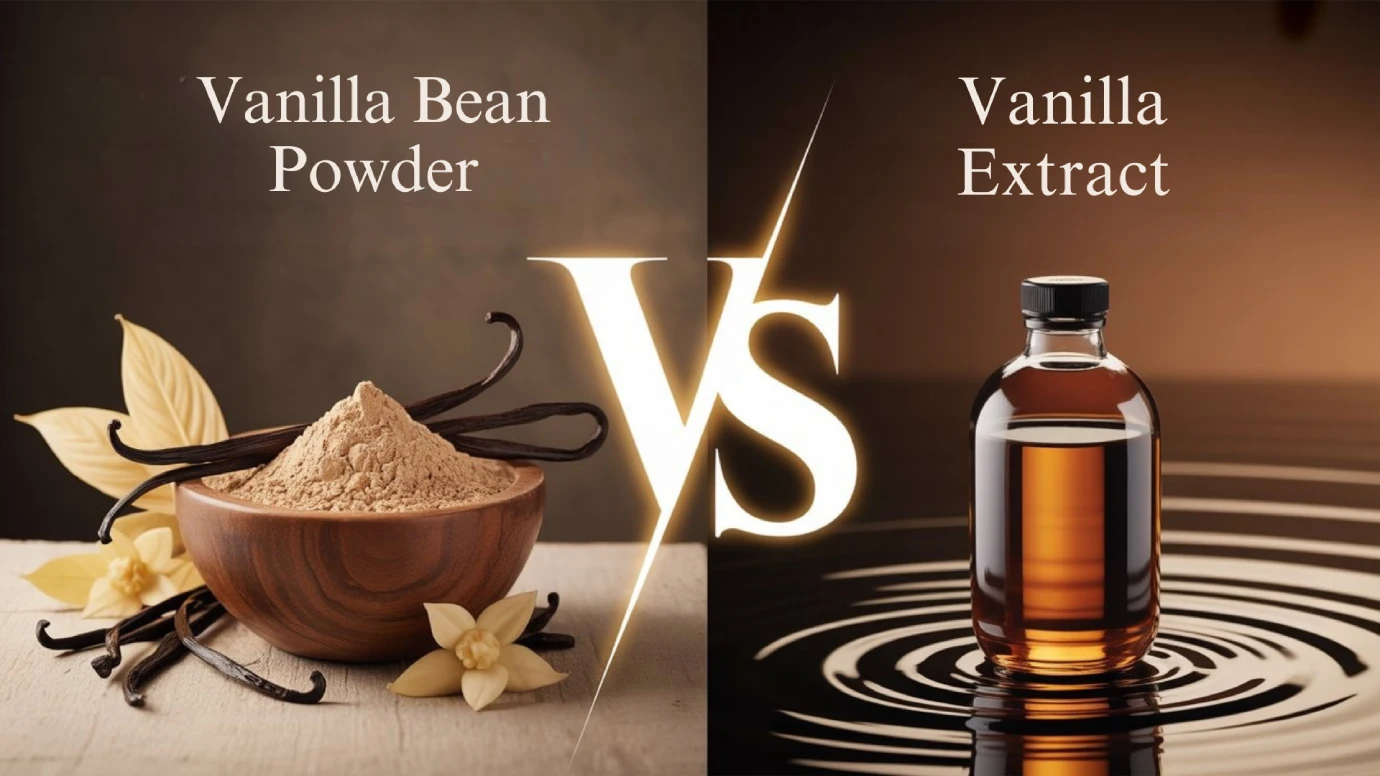
Most recipes call for vanilla extract. Vanilla bean powder rarely makes an appearance — and that is partly a familiarity problem. Both come from the same pod. They taste the same at the source. But they behave differently in the kitchen, and knowing which to reach for changes your results. For a deeper look at origins, grades, and what to look for when shopping, see our guide on buying vanilla beans. If you’re making homemade vanilla extract, visit our extract maker guide for bean recommendations and ratios.
What each one is
Vanilla extract is made by macerating vanilla beans in alcohol. The alcohol pulls out the flavor compounds — primarily vanillin — and carries them into your recipe when the liquid is added. The FDA requires a minimum of 35% alcohol and 13.35 oz of beans per gallon for a product to be labeled pure vanilla extract.
Vanilla bean powder is simpler: whole Grade A pods, ground fine. No alcohol, no water, no carriers. What you get is a dark brown powder with the same flavor compounds, more concentrated — nothing has been diluted.
When vanilla bean powder wins
- Dry applications — Whipped cream, dry rubs, coffee, smoothies, powdered sugar icings. Liquid extract can thin whipped cream, introduce a faint alcohol note, or clump powdered sugar. Powder does none of that.
- High-heat baking — Some of the volatile aroma compounds in vanilla extract burn off at oven temps above 375°F. Powder is less volatile; more flavor survives a long bake. Worth it for shortbread, biscotti, and anything that bakes dry.
- Alcohol-free cooking — If you are baking for someone who avoids alcohol for religious, medical, or personal reasons, powder is the direct solution. No substitution math, no flavor compromise.
- When you want the speckle — The tiny dark flecks of vanilla are a visual cue that tells anyone eating a macaron or a panna cotta exactly what is in it. Powder delivers that; extract does not.
When vanilla extract wins
- Wet batters and doughs — Cookies, cakes, quick breads. Extract disperses completely into wet ingredients without any extra step. It is what recipe developers test with, so it is what recipes are calibrated for.
- Cold applications — Ice cream bases, custards, no-bake cheesecakes. The alcohol in extract carries flavor into cold fats efficiently — more so than powder.
- High volume — For large-batch baking, a gallon of extract goes further than the equivalent in powder. If you make your own vanilla extract with Amadeus beans, you are already getting the most from every pod.
Can you substitute one for the other?
Yes. The standard conversion: 1/2 teaspoon vanilla bean powder = 1 whole vanilla bean = 1 teaspoon pure vanilla extract.
That swap works in most recipes. Powder is slightly more concentrated, so in a delicate preparation — a pastry cream, a light mousse — start with a little less and adjust to taste.
Which to choose from Amadeus
We carry two vanilla bean powders, both 100% ground Grade A pods with nothing added — no fillers, no silicon dioxide, no artificial flavoring.
- Madagascar Vanilla Bean Powder — smooth, warm, buttercream notes. The flavor that anchors most desserts. Reach for this when vanilla is the main event.
- Uganda Vanilla Bean Powder — bolder, with a dark-chocolate character and higher vanillin content. Outstanding in chocolate cake, brownies, and dark roast coffee.
Both are sourced direct from family farms and co-operatives — the same supply chain as our whole beans and extract-grade lines. If you need larger quantities for a food business or commercial kitchen, our wholesale team handles orders from 10 kg up. Learn more about our sourcing and all four SKUs on our Madagascar vanilla beans page.
What is vanilla bean powder?
Vanilla bean powder is made from whole ground vanilla beans with no liquid or carrier added. It contains the full vanillin, natural oils, and visible seed specks from the pod. It is alcohol-free and shelf-stable.
What is vanilla extract?
Pure vanilla extract is made by steeping vanilla beans in alcohol. The FDA standard requires 13.35 ounces of vanilla beans per gallon of alcohol — about 0.83 ounces per 8 fluid ounces — and a minimum of 35% alcohol by volume.
How much vanilla bean powder equals vanilla extract?
Use 1/2 teaspoon of vanilla bean powder in place of 1 teaspoon of pure vanilla extract. Powder is more concentrated by weight because it contains no water or alcohol.
When should I use vanilla bean powder instead of extract?
Use powder in dry applications (spice blends, dry baking mixes, coating chocolate), when you want visible vanilla specks in white frosting or buttercream, when the recipe needs to be alcohol-free, or when added liquid would throw off the recipe balance.
When should I use extract instead of vanilla bean powder?
Use extract for most standard baking — cookies, cakes, custards, sauces, and beverages. Extract distributes evenly in liquid batters and is the most convenient form for everyday cooking.