
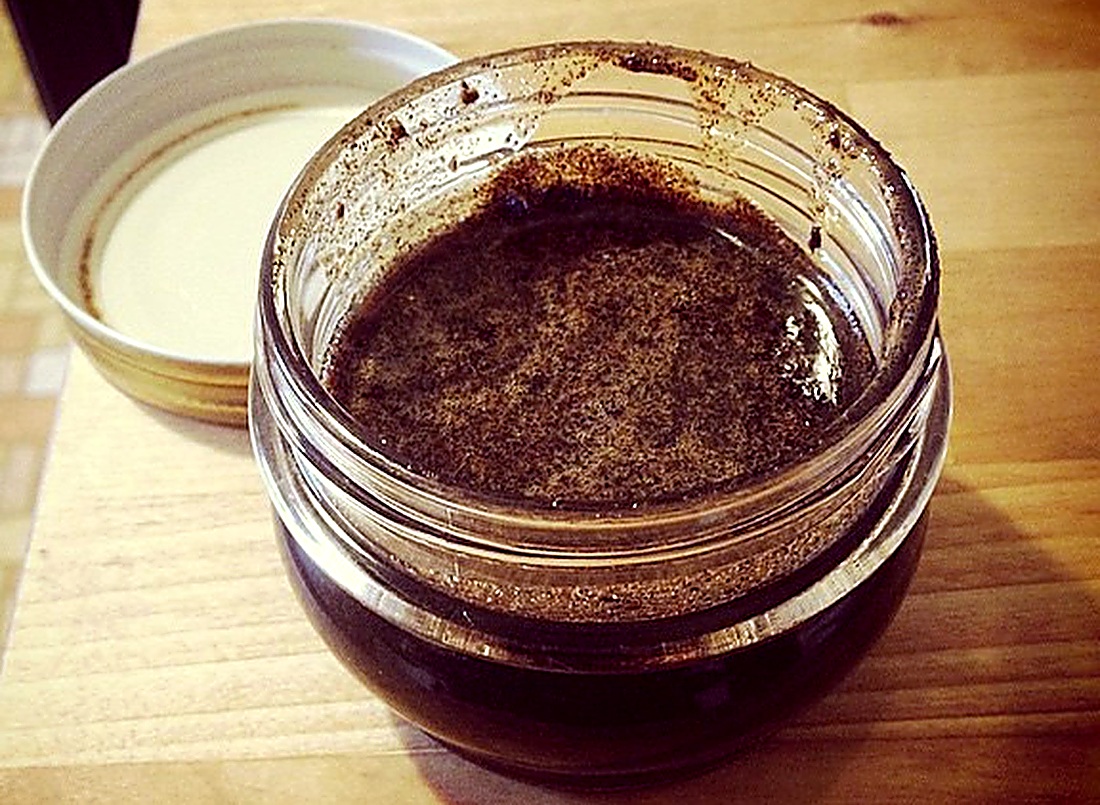
Vanilla bean paste is ground vanilla bean suspended in a thick, sweet base — spoonable, and you can see the seeds.
Photo: amy.z, CC BY 2.0 (cropped, colour-corrected)
Vanilla bean paste is extract’s thicker cousin: it carries the same alcohol-based vanilla flavor but adds ground bean pulp and seeds suspended in a syrup base. The result is a spoonable, dark brown paste studded with black specks. Use paste when the specks matter visually — custards, ice cream, cheesecake, pastry cream. Use extract when the appearance doesn’t benefit from visible seeds — most cakes, cookies, sauces, and batters where a clean, even flavor is all you need. Substitute 1:1 by volume in either direction.
What Vanilla Bean Paste Actually Is
Commercially made paste typically contains vanilla extract, ground vanilla bean powder or scraped seeds, a thickener (usually sugar syrup or gum), and sometimes a small amount of glycerin to hold everything together. The vanilla content varies by brand, but a good paste delivers roughly the same vanillin concentration as a pure extract — just with the textural and visual bonus of the whole bean.
The black specks aren’t decoration. They’re the tiny seeds from inside a cured vanilla pod, and they carry genuine flavor compounds alongside the visual drama. A spoonful of paste stirred into crème brûlée custard or folded into whipped cream announces “scratch-made” in a way that invisible liquid cannot.
When Paste Wins
Reach for paste when the specks improve the finished dish:
- Ice cream and gelato — Seeds are visible throughout and signal real vanilla to anyone eating it
- Cheesecake and custard tarts — A pale filling dotted with black specks is a classic presentation cue
- Crème brûlée and panna cotta — Light-colored dairy desserts show the seeds clearly
- Buttercream and cream cheese frosting — Specks visible in the piped finish
- Pastry cream and diplomat cream — The filling inside an éclair or mille-feuille reads better with visible bean
The thick base also helps in applications where a small amount of liquid would thin the mixture. A tablespoon of paste adds less water activity than a tablespoon of extract, which can matter in dense fillings.
When Extract Wins
Extract is the right call when visual specks don’t add anything — or when they’d be out of place:
- Chocolate cakes and dark batters — Seeds disappear into the color; clean flavor is all that matters
- Snickerdoodles, shortbread, and most drop cookies — Specks aren’t visible in the baked result
- Savory vanilla sauces — A lobster bisque or vanilla vinaigrette doesn’t benefit from flecks
- Beverages — Coffee, smoothies, and cocktails where a uniform liquid blends cleanly
- Large-batch baking — Extract dissolves instantly; paste can require extra stirring to distribute evenly
If you’re curious how extract compares to powder as a flavoring tool, we go deep on that in our vanilla bean powder vs. extract guide.
The Substitution Ratio
1 teaspoon paste = 1 teaspoon extract. That’s it. The flavor intensity is calibrated to match in most commercial pastes, so no math required. If you’re scaling a recipe up or down, keep the same 1:1 ratio throughout.
How to Make Your Own Vanilla Bean Paste
Two ways to do it, depending on what you’re starting from. Neither one needs a drop of store-bought extract, and neither needs anything fancier than a bowl or a blender.
From Vanilla Powder (the fast way)
Whisk 2 tablespoons of finely ground Madagascar vanilla powder into a base of 3 tablespoons food-grade vegetable glycerin and 3 tablespoons heavy simple syrup, then leave it at room temperature for 24 to 48 hours to hydrate into a thick, glossy paste. Full step-by-step instructions, the fixes for grit and lumps, and the reason the flavor keeps improving for a week or two after the texture is already finished are in our guide to making vanilla bean paste from vanilla powder.
From Whole Vanilla Beans (makes about 28 oz)
If you’d rather start from whole pods — and if you want a batch big enough to last a kitchen a while — this one goes in a blender instead of a bowl. The sugar and alcohol do the extracting, so the beans give up their flavor as they break down. Either gourmet or extract-grade beans work here; extract grade is the more economical choice and it’s exactly what it was cured for.
- 4 oz vanilla beans, gourmet or extract grade, cut into 2–3″ pieces
- 2 cups granulated sugar
- 12 oz plain 80-proof vodka (rum or whiskey give you a different profile; food-grade vegetable glycerin makes it alcohol-free, with slightly milder extraction)
- 6 tablespoons light corn syrup
- 1–4 tablespoons water — start with 1–2, add more only if the blender struggles
- Optional: ¼ to ½ teaspoon xanthan gum, for a thicker paste
- Build the base. Combine the sugar, vodka, corn syrup, and 1–2 tablespoons of water in a high-speed blender.
- Add the beans. Cut them into 2–3″ lengths first so the blade can catch them. If your pods feel dry or brittle, soften them in a couple of tablespoons of warm water beforehand and hold back the water in the base accordingly.
- Blend. Run it on the highest speed for 2 to 3 minutes, until the mixture is smooth and the bean pieces are down to the size of coarse black pepper. If they’re still bigger, pulse in short bursts.
- Thicken, if you like. With the blender on medium, sprinkle the xanthan gum in slowly and run another 30 seconds.
- Store. Pour into containers with tight-fitting lids and keep them somewhere dry and dark at room temperature, away from heat. It holds up to a year.
Two things to expect. It will look thin when you pour it — give it a day or two and it thickens up on its own. And for the first couple of weeks the alcohol reads strongly, so use it in things that get cooked. After about two weeks that blows off, the vanilla comes forward, and it’s lovely in uncooked applications like whipped cream and yogurt.
Why both sugars? They’re doing different jobs and it’s worth keeping both. The granulated sugar balances the flavor and thickens the paste; the light corn syrup is what stops it crystallizing in the jar. If you’d rather not use corn syrup, homemade invert sugar substitutes for it — honey or agave will work too, though they shift the sweetness. This method halves cleanly if 28 oz is more than you need.
The whole-bean method is adapted from The Salted Pepper’s vanilla bean paste.
We don’t sell ready-made paste — but we sell both inputs. The Madagascar vanilla powder and whole gourmet beans Cassie and Marty source are cured by the same Malagasy co-operative farms that have supplied Amadeus since Glenn founded the company in 1994. The quality in the paste is only as good as what goes into it.
FAQ
Is vanilla bean paste better than extract?
Neither is universally better. Paste is better when black specks improve the presentation or when you want a slightly thicker flavoring agent. Extract is better for seamless integration in dark, complex, or liquid applications. Keep both on hand and choose based on the dessert.
What’s the paste-to-extract ratio?
1:1 by volume. One teaspoon of paste replaces one teaspoon of extract, and vice versa.
Do I need vanilla extract to make vanilla bean paste?
No. Most commercial pastes are built on extract, but neither method above uses any. If you start from vanilla powder the flavor is already in the jar — the powder is ground vanilla bean — so all it needs is a base to carry it, and glycerin plus a heavy simple syrup does that. The powder method leaves you an alcohol-free paste. If you start from whole beans, the vodka does the extracting itself, right there in the blender.
Can I make vanilla bean paste without a food processor?
Yes — use the powder method. Starting from vanilla powder means no processing at all: a bowl, a whisk, and a day or two of hydrating. The whole-bean method is the one that needs equipment, and it wants a high-speed blender rather than a food processor, since it has to break the pods down to the size of coarse black pepper.
How long does homemade paste keep?
About a year, either way. The powder-and-glycerin paste holds a year or more in an airtight glass jar kept cool and dark or refrigerated — there’s very little water in it and the sugar base does the rest. The whole-bean version keeps up to a year at room temperature somewhere dry and away from heat and light, with the alcohol working as the preservative. Discard either if it smells off or shows any mold.
Amadeus has been importing vanilla directly from family farms and co-operatives since 1994. Browse our gourmet vanilla beans and Madagascar vanilla powder — the two ingredients you need to make paste at home.